

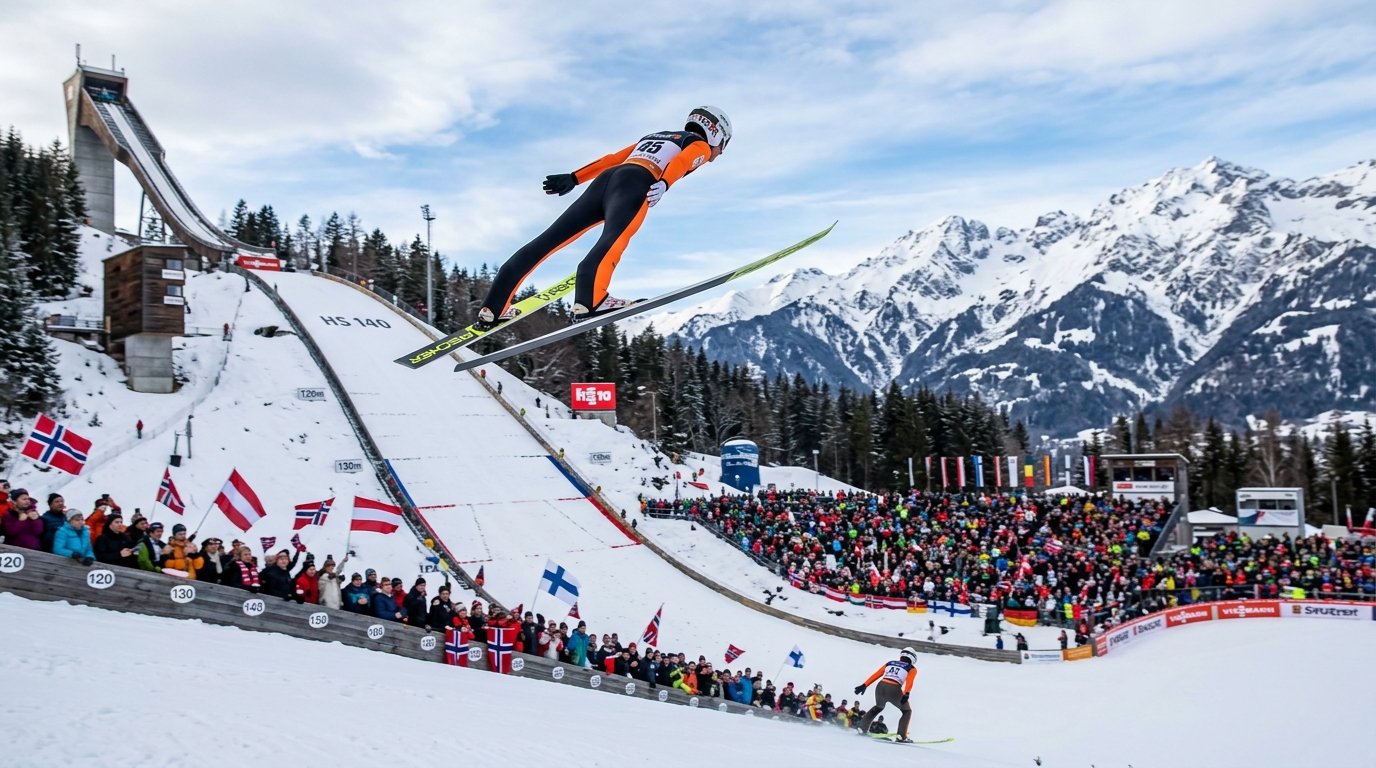
Watching athletes soar through the sky in Ski jumping can feel almost unbelievable. For a few remarkable seconds, they appear to glide effortlessly above the snow, covering incredible distances before landing with precision. It often looks less like a sport and more like human flight.
This naturally raises an intriguing question: how do ski jumpers stay in the air for so long, and what kind of training allows them to perform such an extraordinary feat?
The answer combines science, athleticism, technical mastery, and mental discipline. Ski jumpers do not simply leap and hope for the best. Every second of flight depends on carefully controlled physics, years of practice, and an exceptional understanding of body movement.
The Physics of Staying Airborne
At its core, ski jumping is a highly refined balance of forces. The moment a jumper leaves the ramp, four primary forces begin to interact:
- Gravity, which pulls the athlete downward
- Lift, which helps keep them in the air
- Drag, which resists forward motion
- Momentum, which carries them down the hill and through the air
A successful jump happens when the athlete maximizes lift while minimizing drag. This allows them to remain airborne much longer than a standard leap would permit.
Unlike an airplane, a ski jumper does not have an engine. Instead, they rely entirely on speed, body position, and aerodynamic efficiency.
Why Ski Jumpers Appear to Fly
The reason ski jumpers seem to float is because they create an aerodynamic shape that interacts exceptionally well with moving air.
Their skis and body function much like a wing. As air moves over and under their body, differences in pressure generate lift. This upward force slows their descent and extends their flight.
The larger the effective surface area and the better the body angle, the more lift they can produce.
This is why technique matters so much. A small adjustment in posture can dramatically affect flight distance.
The Revolutionary V-Style Technique
One of the biggest advancements in ski jumping came with the introduction of the V-style.
In this technique, jumpers spread their skis outward so that the tips form a V shape while the tails remain closer together. This position increases the surface area exposed to airflow, generating significantly more lift.
Benefits of the V-style include:
- Greater aerodynamic efficiency
- Improved stability during flight
- Longer jump distances
- Better control in varying wind conditions
Before this technique became standard, athletes kept their skis parallel. While effective for its time, the parallel method produced much less lift.
The V-style transformed the sport and remains one of the most important innovations in ski jumping history.
The Critical Role of Speed
Flight begins long before takeoff. Ski jumpers accelerate down the inrun at extraordinary speeds, often reaching between 85 and 100 kilometers per hour, depending on the hill size.
This speed is essential because it creates the momentum needed for lift.
The faster the jumper travels:
- The more airflow moves over the skis
- The greater the lift generated
- The farther they can travel
Without sufficient speed, even flawless technique would result in a shorter jump.
Takeoff: The Most Explosive Moment
Takeoff lasts only a fraction of a second, yet it is one of the most important phases of the entire jump.
At the exact end of the ramp, the athlete must extend powerfully through the legs, converting forward speed into upward and forward motion.
A perfect takeoff requires:
- Explosive leg strength
- Exceptional timing
- Precise body alignment
- Strong balance and coordination
If the jumper pushes too early, they lose efficiency. If they push too late, they sacrifice distance and stability.
This split-second movement is practiced endlessly.
Body Position During Flight
Once airborne, ski jumpers adopt one of the most aerodynamic positions in all of sports.
They lean far forward, keeping their chest close to their skis. Their body remains almost parallel to the ski surface, with arms positioned carefully to reduce drag.
This posture helps them:
- Maintain lift
- Reduce air resistance
- Improve stability
- Control direction
Even the position of the head matters. Looking too high or too low can alter airflow and reduce efficiency.
Elite jumpers refine these details to an extraordinary degree.
How Wind Affects Flight
Wind plays a major role in ski jumping performance.
A gentle headwind can actually help athletes by increasing lift, allowing them to stay airborne longer. On the other hand, a tailwind can reduce lift and shorten jumps.
Competition organizers carefully monitor wind conditions to ensure fairness and safety.
Modern scoring systems even adjust points based on wind conditions, recognizing the significant impact wind has on performance.
Physical Training: Building Explosive Power
Ski jumpers require a highly specialized type of strength. They do not aim for bulk; instead, they focus on explosive, functional power.
Lower-Body Strength Training
Strong legs are essential for takeoff. Common exercises include:
- Squats
- Deadlifts
- Lunges
- Step-ups
- Bulgarian split squats
These movements build the power needed to launch off the takeoff table.
Plyometric Training
Plyometrics improve explosive force and reaction speed.
Popular drills include:
- Box jumps
- Depth jumps
- Bounding exercises
- Single-leg hops
These exercises mimic the explosive nature of takeoff.
Core Strength and Stability
A ski jumper must maintain a highly demanding flight position while resisting air forces.
This requires exceptional core strength.
Core training often includes:
- Planks
- Hanging leg raises
- Rotational exercises
- Stability ball drills
- Anti-rotation movements
A strong core allows athletes to hold their aerodynamic posture without losing control.
Balance and Coordination Development
Few sports demand as much balance as ski jumping.
Athletes regularly train using:
- Balance boards
- Slacklines
- Bosu balls
- Single-leg stability drills
- Dynamic coordination exercises
These workouts improve body awareness and fine motor control.
This is especially important during takeoff and landing, where even minor instability can affect performance.
Technical Training on the Hill
Physical conditioning alone is not enough. Ski jumpers spend countless hours practicing technique on training hills.
They focus on:
- Inrun posture
- Takeoff timing
- Flight positioning
- Landing mechanics
Coaches analyze each jump in detail, often using slow-motion video to identify areas for improvement.
At elite levels, even tiny adjustments can lead to significant gains.
Summer Training on Plastic Hills
Ski jumpers train year-round, not just in winter.
Specially designed hills covered with synthetic plastic surfaces allow athletes to practice during warmer months.
Summer training helps them:
- Maintain technical consistency
- Refine movement patterns
- Build confidence
- Prepare for the winter season
This continuous practice is essential for long-term development.
Wind Tunnel and Simulation Training
Modern ski jumping increasingly uses advanced technology.
Wind tunnels allow athletes to test body positions under controlled airflow conditions. These sessions help determine the most efficient aerodynamic posture.
Simulation tools and motion analysis systems also provide valuable feedback, enabling athletes to fine-tune their technique.
Technology has become an integral part of elite ski jumping preparation.
Mental Training and Focus
Standing at the top of a ski jump requires immense mental strength.
Athletes must remain calm, focused, and confident despite the obvious risks.
Mental training often includes:
- Visualization exercises
- Breathing techniques
- Concentration drills
- Pre-jump routines
- Performance psychology sessions
Visualization is especially important. Many jumpers mentally rehearse every phase of the jump before leaving the start gate.
The Importance of Landing Technique
A great jump is not complete until the landing.
Ski jumpers use the classic Telemark landing, where one ski lands slightly ahead of the other.
This technique offers several advantages:
- Improved stability
- Better shock absorption
- Higher style scores
- Greater control
Judges reward smooth, controlled landings, making this phase critical in competition.
Injury Prevention and Recovery
Because ski jumping places significant stress on the body, recovery is a key part of training.
Athletes prioritize:
- Mobility work
- Stretching
- Massage therapy
- Recovery sessions
- Proper sleep and nutrition
Preventive conditioning helps reduce the risk of injuries, especially to the knees, hips, and lower back.
Why Ski Jumpers Can Stay in the Air So Long
Ultimately, ski jumpers stay airborne because they combine:
- High approach speed
- Explosive takeoff power
- Advanced aerodynamic positioning
- Efficient use of lift
- Exceptional technical skill
Their flight is not accidental. It is the result of precise scientific principles applied through years of disciplined training.
What looks effortless is actually one of the most technically demanding performances in sport.
Final Thoughts
Ski jumping is a remarkable blend of physics, athleticism, and artistry. Athletes appear to fly because they have mastered the science of lift, drag, and momentum while developing extraordinary strength, balance, and control.
Their training is equally impressive. From explosive power workouts and balance drills to wind tunnel analysis and mental conditioning, every aspect of preparation serves a purpose.
So, how do ski jumpers stay in the air so long? Through a perfect combination of speed, technique, and aerodynamic precision.
And how do they train for it? With relentless dedication, scientific insight, and years of practice.
