

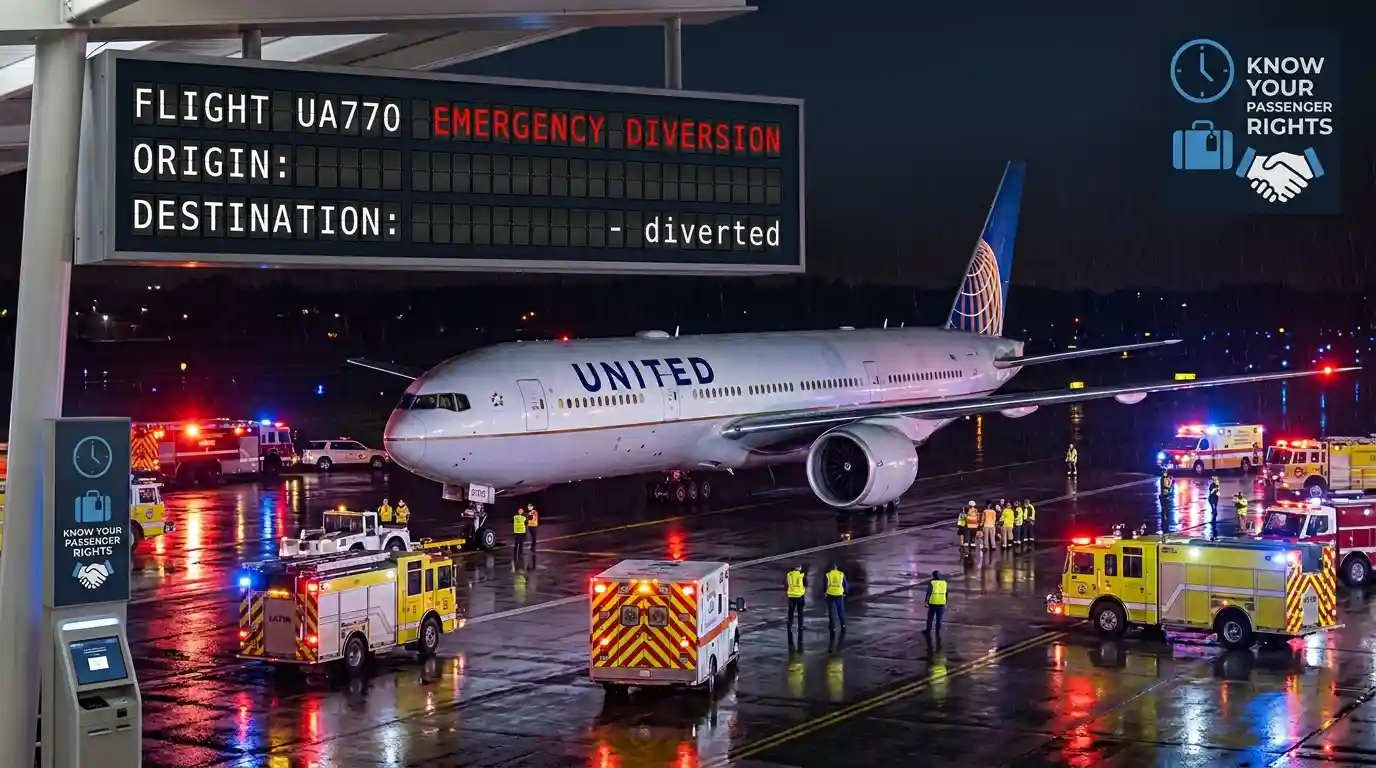
The United Airlines Flight UA770 emergency diversion is a clear example of how modern aviation prioritizes safety above all else, even when it leads to unexpected disruptions for passengers. The incident involved a long-haul journey operated by United Airlines, where the aircraft had to change its planned route due to an in-flight situation, resulting in a diversion to London Heathrow Airport instead of continuing to its original destination, Chicago.
This event highlights how complex decisions in aviation are made in real time to ensure passenger safety while also raising important questions about flight diversion, airline responsibilities, and passenger rights.
Overview of United Airlines Flight UA770 Emergency Diversion
The Flight UA770 was originally scheduled to operate from Barcelona to Chicago using a Boeing 787-9 aircraft. During the flight, while crossing the English Channel, the crew decided to divert the aircraft to London Heathrow Airport, a major international hub equipped to handle emergency landings and technical support.
Such decisions are not uncommon in aviation and are always taken with one primary goal: ensuring the safety and well-being of everyone on board.
Why Flight Diversions Like UA770 Happen
A flight diversion can occur for several reasons, and airlines must act quickly when unexpected situations arise. In the case of the United Airlines flight UA770 emergency diversion, the exact cause was not immediately confirmed publicly, but aviation experts explain that diversions generally happen due to:
1. Mechanical Issues
Technical problems are one of the most common reasons for diversion. These may include:
- Engine issues
- Hydraulic system failure
- Electrical malfunctions
- Navigation system errors
- Fuel or pressure system concerns
Even minor irregularities can lead to a precautionary diversion to ensure safe landing conditions.
2. Medical Emergencies
A sudden medical situation involving a passenger or crew member can require immediate landing at the nearest suitable airport.
3. Weather Conditions
Severe weather such as storms, heavy turbulence, fog, or strong winds can force rerouting for safety reasons.
4. Unruly Passenger Behavior
If a passenger behaves aggressively or disruptively, it can lead to an emergency diversion for security reasons.
5. Operational and External Factors
Other causes include:
- Airspace restrictions
- Political unrest
- Airport closures
- Night flight ban limitations at destination airports
The Role of London Heathrow Airport in UA770 Diversion
In this case, London Heathrow Airport served as the emergency landing point. It is one of the busiest and most well-equipped airports in the world, capable of handling large aircraft like the Boeing 787-9 and providing immediate technical and medical support if required.
Passenger Experience During Flight Diversion
For passengers on Flight UA770, the diversion likely caused confusion and delay, as the aircraft did not reach its planned destination of Chicago. Instead, passengers had to adjust to an unexpected stop in London.
Such situations are often stressful, but airlines are required to prioritize:
- Passenger safety
- Communication updates
- Basic care services during delays
- Rebooking arrangements if needed
Passenger Rights and Compensation Rules
Under frameworks like the Air Passenger Rights Regulation, passengers may be entitled to assistance depending on the reason for the diversion.
When Compensation May Apply
Passengers may be eligible for compensation if the diversion is caused by airline-related issues such as:
- Technical or mechanical failure
- Operational mismanagement
- Preventable airline faults
When Compensation May Not Apply
Certain situations are considered extraordinary circumstances, such as:
- Severe weather conditions
- Political instability or civil unrest
- Air traffic controller strikes
- Airport staff strikes
- Security threats or emergency restrictions
In such cases, airlines are still responsible for providing care services but may not be required to pay financial compensation.
Care and Assistance Provided by Airlines
Even when compensation is not applicable, airlines like United Airlines must ensure passenger support, which may include:
- Meals and refreshments during delays
- Hotel accommodation if overnight stay is required
- Transport between airports or hotels
- Rebooking assistance for onward travel
If a night flight ban or airport restriction forces diversion, airlines also coordinate alternative travel arrangements.
Importance of Documentation for Claims
Passengers affected by the United Airlines flight UA770 emergency diversion are advised to keep proper records, including:
- Boarding passes and tickets
- Delay or diversion notices
- Meal and transport receipts
- Written communication from airline staff
This documentation helps when submitting a compensation claim or requesting reimbursement.
Conclusion
The United Airlines Flight UA770 emergency diversion demonstrates how aviation safety systems operate under strict protocols to protect passengers. While diversions can be inconvenient, they are always carried out with safety as the top priority.
From Barcelona to Chicago, the unexpected stop at London Heathrow Airport shows how quickly flight paths can change due to operational, technical, or safety-related factors. Understanding flight diversion rules and passenger rights helps travelers stay informed and prepared when such rare situations occur.
In modern aviation, safety always comes first—and UA770 is a clear example of that principle in action.
