

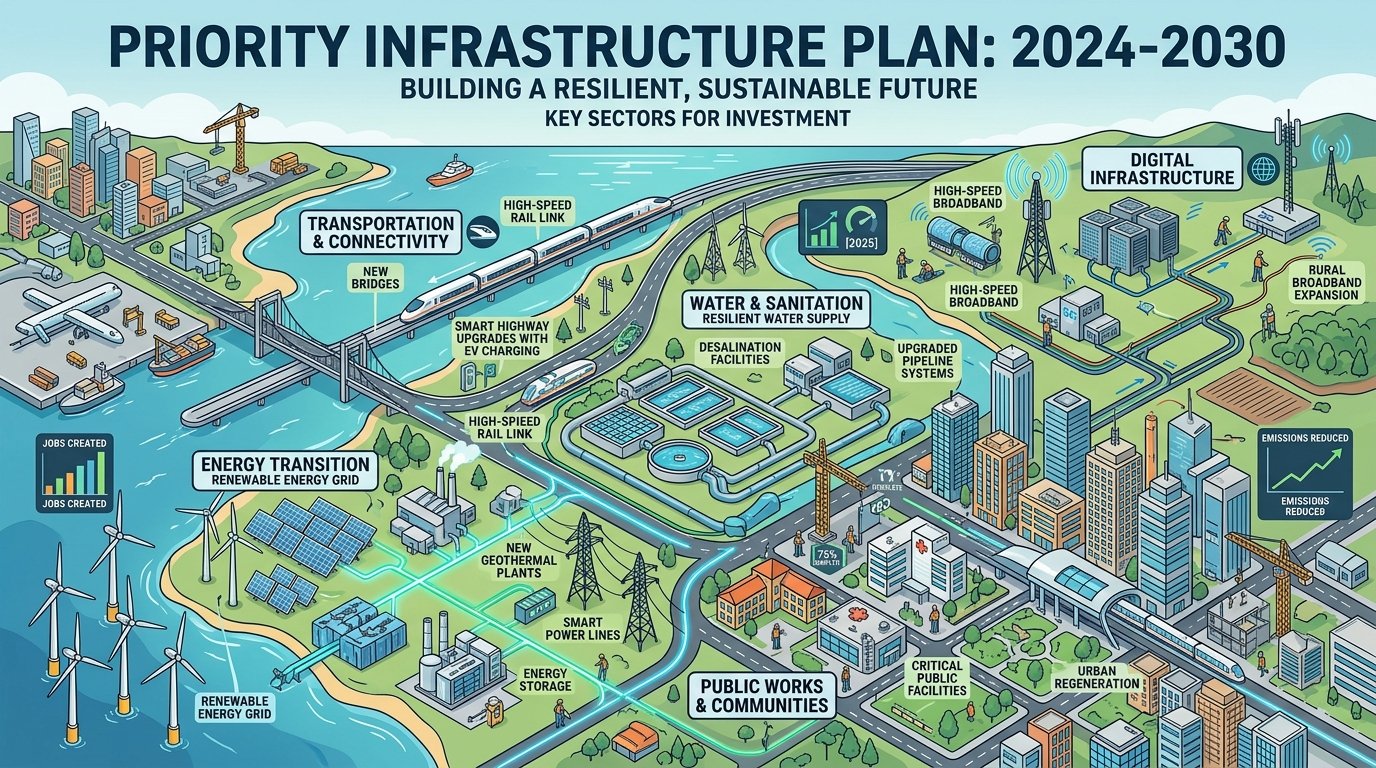
Development is no longer just about building more roads, houses, or utilities. It is about building them in the right order, at the right time, and in the right places. This is exactly where the concept of a Priority Infrastructure Plan becomes essential.
A Priority Infrastructure Plan is a structured framework used by governments, planning authorities, urban planners, and engineers to guide long-term development decisions. Instead of reacting to problems as they appear, it focuses on anticipating future needs and prioritizing the most critical infrastructure first.
From transportation networks and water supply systems to electricity networks and drainage systems, every element of urban infrastructure is carefully evaluated and scheduled based on urgency, impact, and feasibility.
Purpose of a Priority Infrastructure Plan
The main purpose of a Priority Infrastructure Plan is to ensure that urban and regional development systems grow in a balanced and sustainable way. Cities often face challenges when population growth trends rise faster than available infrastructure.
Without structured planning, problems such as traffic congestion, water shortages, and overloaded utility networks become common. This plan helps prevent such issues by ensuring that essential systems are developed before large-scale expansion begins.
It acts as a long-term roadmap that connects economic forecasts, industrial growth, and housing demand with real infrastructure delivery.
How Planning Authorities Shape Infrastructure Priorities
A major role in this process is played by planning authorities and technical experts such as urban planners, engineers, and financial experts. They work together to analyze data and decide which projects should come first.
This involves multiple stages:
- Collecting data on population and infrastructure usage
- Evaluating existing road infrastructure and utility systems
- Identifying pressure points in energy infrastructure and water supply
- Assessing future demand using forecasting models
- Aligning development with economic forecasts and urban expansion plans
This structured process ensures that decisions are not random but based on evidence and long-term planning.
Role of Data and Technology in Infrastructure Planning
Modern Priority Infrastructure Plans heavily rely on technology. Tools like digital modeling, artificial intelligence (AI), and real-time data analysis have transformed how cities plan development.
These systems help planners:
- Predict future housing demand
- Monitor transportation networks usage
- Analyze drainage systems capacity during heavy rainfall
- Improve decision-making through data-driven decision making
With AI and predictive tools, governments can identify risks before they become serious problems, making infrastructure planning more efficient and reliable.
Key Infrastructure Elements in Priority Planning
A Priority Infrastructure Plan covers multiple essential systems that support daily life and economic activity. Each system is ranked based on urgency and importance.
Transportation and Connectivity Systems
Transportation networks are often a top priority because they directly affect mobility, trade, and productivity. Efficient roads and transit systems reduce congestion and support industrial growth and employment.
Water and Utility Systems
Reliable water supply systems and utility networks are essential for both residential and industrial areas. These systems are prioritized to ensure public health and continuous service delivery.
Energy Infrastructure
Stable electricity networks and modern energy infrastructure are critical for supporting businesses, industries, and digital systems. Without proper energy planning, economic development slows down significantly.
Environmental and Drainage Systems
Proper drainage systems and environmental planning help manage flooding and climate-related risks. These systems are part of long-term environmental resilience strategies.
Economic Importance of Priority Infrastructure Planning
A well-structured Priority Infrastructure Plan plays a major role in boosting economic development. Infrastructure is closely linked to trade and logistics systems, industrial expansion, and job creation.
When infrastructure is developed in the right sequence:
- Businesses operate more efficiently
- Transportation costs are reduced
- Industrial zones grow faster
- Employment opportunities increase
This creates a positive cycle where infrastructure supports industrial growth, and industrial growth further demands better infrastructure.
Managing Environmental Risks and Climate Challenges
Modern infrastructure planning also focuses heavily on environmental risks and climate challenges. Cities today must prepare for issues such as flooding, heat waves, and resource shortages.
To address this, planners include:
- Climate change risks assessments
- Sustainable construction practices
- Long-term environmental resilience strategies
- Integration of green infrastructure systems
These approaches ensure that development is not only fast but also environmentally responsible.
Phased Development and Project Prioritization
One of the most important features of a Priority Infrastructure Plan is phased development planning. Since resources are limited, not all projects can be completed at once.
Instead, infrastructure projects are divided into stages:
- Short-term projects focus on urgent needs like damaged roads or overloaded utilities
- Medium-term projects support growing urban areas
- Long-term projects prepare cities for future expansion
This structured approach ensures better use of funding cycles and reduces waste in public spending.
Challenges in Implementation
Despite its advantages, implementing a Priority Infrastructure Plan comes with challenges.
One major issue is uncertainty in economic forecasts and population trends. Unexpected changes can affect long-term planning models.
Another challenge is coordination between multiple agencies. Since infrastructure involves different departments, aligning all stakeholders under one system can be complex.
Funding limitations also affect how quickly projects can move forward. Even well-prioritized plans may face delays due to budget constraints.
More Read: Nerwey: Modern Concept Shaping Digital Identity & Innovation
The Future of Priority Infrastructure Planning
The future of infrastructure planning is becoming more intelligent and adaptive. With advancements in AI, digital modeling, and smart city technologies, planning systems are evolving rapidly.
Future urban and regional development systems are expected to be:
- More automated
- More data-driven
- More environmentally focused
- More responsive to real-time changes
Planners will increasingly rely on predictive analytics and smart systems to adjust priorities dynamically as conditions change.
Sustainability will also become a central focus, with greater emphasis on green infrastructure development and climate resilience.
Conclusion
A Priority Infrastructure Plan is a development strategy—it is a foundation for sustainable cities and strong economies. By carefully balancing transportation networks, water systems, energy infrastructure, and environmental needs, it ensures that urban growth happens in a structured and efficient way.
Through the use of data-driven decision making, digital modeling, and long-term forecasting, governments and planners can build cities that are not only functional today but also prepared for the future.
In a world where population growth trends and urban demand continue to rise, the importance of structured infrastructure planning will only become more critical in shaping sustainable and resilient societies.
Frequently Asked Questions (FAQs)
1. What is a Priority Infrastructure Plan?
A Priority Infrastructure Plan is a strategic framework used by governments and planning authorities to decide which infrastructure projects should be developed first. It ensures that essential systems like transportation networks, water supply systems, and electricity networks are delivered in a structured and efficient way.
2. Why is a Priority Infrastructure Plan important?
It is important because it helps manage population growth trends, supports economic forecasts, and ensures balanced development across cities. Without it, infrastructure development can become unorganized and inefficient.
3. Which sectors are included in infrastructure planning?
A Priority Infrastructure Plan typically includes road infrastructure, drainage systems, utility networks, energy infrastructure, and transportation networks, all of which are essential for urban growth and daily life.
4. How does technology support infrastructure planning?
Modern planning uses digital modeling, artificial intelligence (AI), and real-time data analysis to improve accuracy. These tools help planners make better data-driven decisions and predict future infrastructure needs.
5. How does a Priority Infrastructure Plan support economic growth?
By improving trade and logistics systems, reducing transport delays, and supporting industrial growth, it creates a strong foundation for economic development and job creation.
