

The modern internet feels almost instant. Websites open in a blink, videos stream without buffering, and apps respond in real time. But behind this smooth experience is decades of innovation driven by powerful technology ideas that transformed web performance.
To understand how the internet became so fast, we need to look at the systems, protocols, and engineering breakthroughs that reshaped how data moves across the world.
1. The Rise of Content Delivery Networks (CDNs)
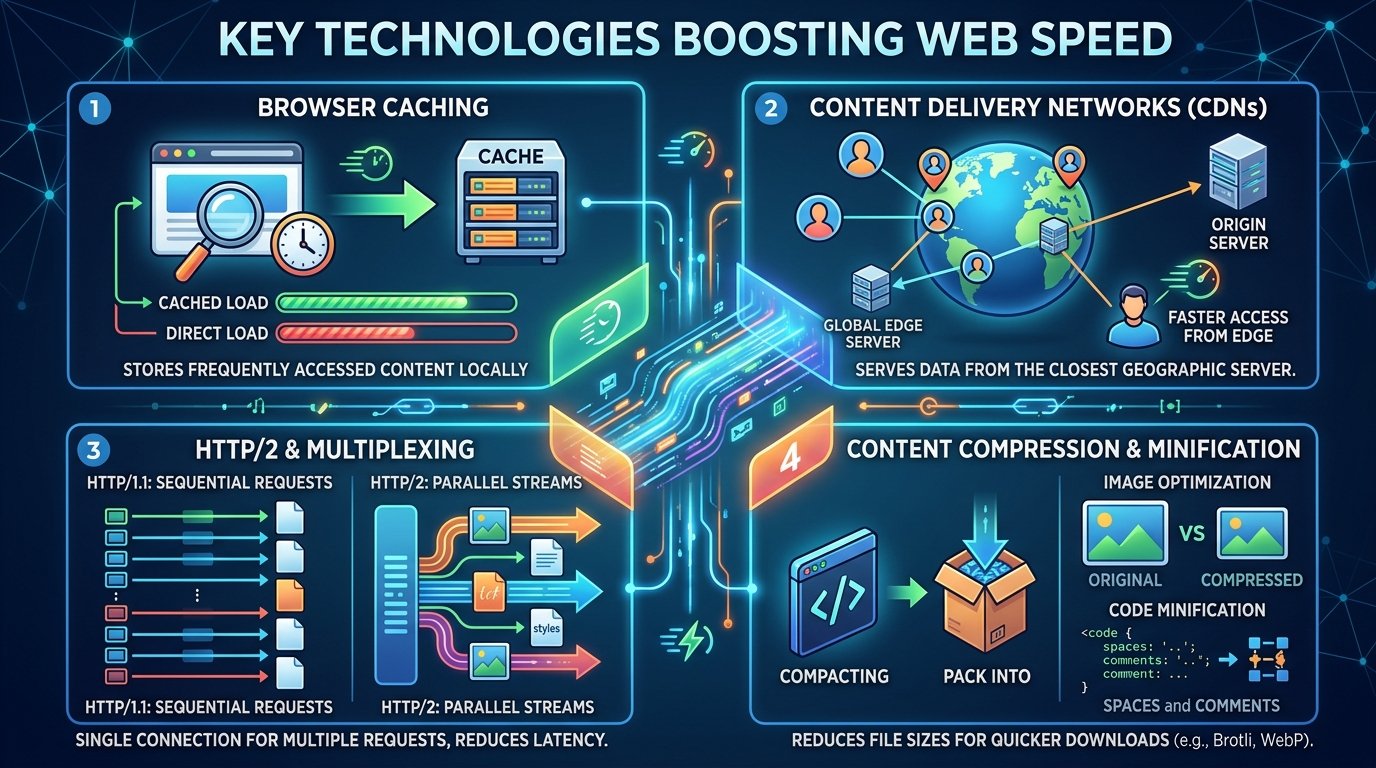
One of the most important breakthroughs in web performance is the Content Delivery Network (CDN).
In the early internet era, websites were hosted on a single server. This created a major limitation: users far from that server experienced slow loading times due to physical distance and network congestion.
CDNs solved this problem by distributing copies of website data across multiple servers located in different regions. When a user accesses a website, the content is delivered from the closest server rather than the main origin server.
This dramatically reduces latency and improves reliability during high traffic.
Impact:
- Faster global access to websites
- Reduced server overload
- Improved user experience across regions
2. HTTP/2 and the Upgrade of Web Communication
The original HTTP/1.1 protocol was simple but inefficient. It could only handle one request at a time per connection, causing delays when loading modern websites that require multiple resources.
The introduction of HTTP/2 changed this completely.
Key improvements included:
- Multiplexing (multiple requests in one connection)
- Header compression (smaller data size)
- Faster connection reuse
These upgrades allowed browsers to load many resources simultaneously instead of waiting in a queue.
Impact:
- Faster page rendering
- Reduced loading bottlenecks
- More efficient data transfer
3. HTTP/3 and QUIC Protocol Innovation
Building on HTTP/2, the web moved further with HTTP/3, which is based on the QUIC protocol developed by Google.
Unlike older systems that rely on TCP, QUIC runs over UDP, which reduces connection delays and improves speed in unstable network conditions.
It also includes built-in encryption and faster handshakes between servers and browsers.
Impact:
- Lower latency
- Faster connection setup
- Better performance on mobile networks
4. Evolution of JavaScript Engines
JavaScript is the backbone of modern interactive websites. However, early browsers executed JavaScript slowly, making dynamic websites laggy.
Modern browsers like Chrome and Firefox introduced highly optimized JavaScript engines such as V8 and SpiderMonkey.
These engines use techniques like:
- Just-in-time (JIT) compilation
- Memory optimization
- Parallel execution
At the same time, modern frameworks like React, Angular, and Vue reduced unnecessary page reloads.
Impact:
- Smooth single-page applications
- Faster dynamic content updates
- App-like web experiences
5. Caching Systems and Data Reuse
Caching is one of the simplest but most powerful ideas that improved web speed.
Instead of downloading everything from scratch every time, browsers store copies of frequently used files like images, scripts, and stylesheets.
There are multiple types of caching:
- Browser caching
- Server caching
- Proxy caching
- CDN caching
This reduces repeated data transfer and speeds up page loading significantly.
Impact:
- Faster repeat visits
- Lower bandwidth usage
- Reduced server pressure
For a deeper understanding of how subdomain issues can affect website structure, indexing, and career-related website setups, you can explore this detailed guide on keine-karriere-subdomain-gefunden
6. Image Compression and Modern Media Formats
In the early web, images were one of the biggest reasons for slow loading times.
Over time, developers introduced advanced compression formats like:
- WebP
- AVIF
- Optimized JPEG and PNG techniques
These formats reduce file size without noticeable loss of quality.
Additionally, lazy loading ensures images load only when needed.
Impact:
- Faster page load times
- Reduced data consumption
- Better mobile performance
7. Cloud Computing Revolution
Cloud computing completely changed how websites and applications are hosted.
Instead of relying on a single physical server, cloud platforms like AWS, Google Cloud, and Azure distribute resources across multiple data centers.
This allows:
- Automatic scaling during traffic spikes
- High availability
- Global infrastructure access
Impact:
- More stable websites
- Faster response under load
- Reduced downtime
8. Edge Computing for Real-Time Speed
Edge computing takes performance even further by processing data closer to the user instead of a central server.
This reduces the distance data must travel, cutting down latency significantly.
It is widely used in:
- Streaming platforms
- Online gaming
- IoT devices
- Real-time applications
Impact:
- Near-instant responses
- Reduced lag
- Better real-time performance
9. Preloading, Prefetching, and Predictive Loading
Modern browsers are becoming smarter.
They now predict user behavior and load resources before they are actually needed.
Techniques include:
- Preloading critical assets
- Prefetching next-page content
- DNS pre-resolution
For example, if a user hovers over a link, the browser may already start loading that page in the background.
Impact:
- Faster navigation
- Seamless browsing experience
- Reduced waiting time
10. WebAssembly for High-Speed Execution
WebAssembly (Wasm) is a modern technology that allows code written in languages like C++ or Rust to run directly in the browser at near-native speed.
It is used for:
- Video editing tools
- Games in the browser
- Heavy computation tasks
Impact:
- High-performance web applications
- Faster execution of complex tasks
- Reduced reliance on traditional JavaScript limitations
11. Lightweight Web Architecture and Optimization
Modern websites are now designed with performance-first thinking.
Developers use:
- Minimalist code structures
- Modular components
- Efficient rendering techniques
- Reduced third-party scripts
This approach ensures websites remain fast even as they become more feature-rich.
Impact:
- Faster load times
- Better mobile experience
- Improved SEO performance
Read More: Ksözcü: Meaning, Origin and Its Role in Modern Communication
Final Thoughts
The speed of today’s internet is the result of continuous innovation across multiple layers of technology. From CDNs and caching systems to HTTP/3, edge computing, and WebAssembly, each idea has contributed to making the web faster, smarter, and more responsive.
What once took seconds or minutes now happens instantly. And as technology continues to evolve, the future web will likely become even more real-time, intelligent, and seamless than what we experience today.
FAQs
1. What are the main technologies that made the internet faster?
The internet became faster due to technologies like CDNs (Content Delivery Networks), HTTP/2 and HTTP/3, caching systems, cloud computing, edge computing, and modern JavaScript engines.
2. How do Content Delivery Networks (CDNs) improve website speed?
CDNs store website data on multiple servers around the world. When a user visits a site, data is delivered from the nearest server, reducing loading time and improving performance.
3. Why is HTTP/3 faster than HTTP/2?
HTTP/3 uses the QUIC protocol, which reduces connection delays and improves speed, especially on mobile and unstable networks. It also loads data more efficiently than older protocols.
4. What is caching in web performance?
Caching is a method where browsers or servers store frequently used data like images and scripts. This allows websites to load faster when users revisit them.
5. How does cloud computing make websites faster?
Cloud computing distributes website data across multiple servers. This allows websites to handle high traffic easily and respond faster to users from different locations.
6. What is edge computing in simple words?
Edge computing processes data closer to the user instead of a central server. This reduces delay and improves real-time performance for apps and websites.
